Burnt or Melted Outdoor GFCI Outlet? What It Really Means
Came home to a burnt or melted outdoor GFCI outlet? Learn what it means, why it happens, and when it’s time to stop DIY and call a licensed electrician.
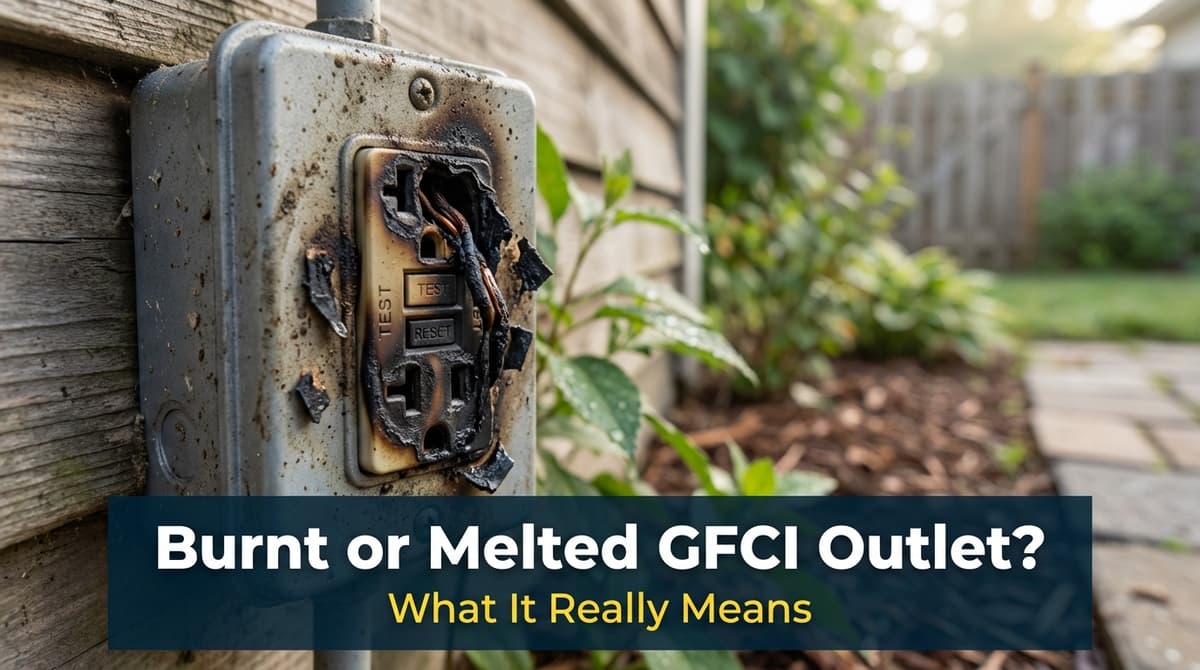
We Got a Call About a Burnt Outdoor GFCI Outlet
We recently got a call from a customer — let’s call him Tom — who had just come home from vacation to a pretty scary surprise. As soon as he walked in the door, he noticed a strong electrical smell in the house. After looking around, he tracked it down to an outdoor GFCI outlet where he had his trailers plugged in.
The outlet cover was discolored, melted, and looked like it may have even been on fire at some point. The plug that had been in it was scorched too. Tom told us he’d been using that outlet for years for his trailers and probably “overdid it” on the load, but it had never given him trouble before.
He was originally planning to just swap it out with a new GFCI from the store, but the more he thought about it, the more it made him nervous. His exact concern was: “I want you guys to make sure there’s not anything that’s going to, you know, burn my house down.” And honestly, that’s the right way to think about a burnt or melted outlet — especially outside.
Why a Burnt or Melted Outdoor GFCI Is a Big Red Flag
A little discoloration is one thing, but if your GFCI outlet looks burnt, melted, or charred, that’s a sign of serious trouble. You might notice:
- Brown or black scorch marks on the outlet or cover
- Plastic that looks bubbled or melted around the slots
- A strong burnt or electrical smell when you get close
- Plugs that are discolored, melted, or hard to remove
All of these point to heat and arcing — in other words, the electrical connection is getting so hot it’s literally damaging the materials. That can be caused by loose connections, corrosion, moisture, or simply too much load on that circuit for too long.
When we hear “burnt” and “GFCI” in the same sentence, we’re not thinking “simple DIY fix.” We’re thinking: find the root cause, fast.
How Outdoor GFCI Outlets Work (and Why They’re Required)
Tom’s outlet was a GFCI (Ground-Fault Circuit Interrupter), which is what you’ll typically see on the outside of a house, in bathrooms, kitchens, garages, and other damp areas. A GFCI is designed to protect you from shock, not from overload.
Here’s the simple version of how it works:
- Electricity goes out on the hot wire and returns on the neutral wire.
- The GFCI constantly compares what goes out vs. what comes back.
- If even a tiny amount of current is “leaking” somewhere else (like through a person to ground), the GFCI trips in a fraction of a second.
That’s why there’s a TEST and RESET button on the face of the device. It’s there to cut power quickly if it detects a ground fault, which is especially likely outdoors where water, wet soil, and metal siding or railings can be involved.
What GFCIs don’t do is act like a circuit breaker for heavy loads. If you plug multiple high-draw items — like RVs, trailers, heaters, or large tools — into one circuit, you can still overheat the wiring or the outlet itself even if the GFCI never trips.
Common Reasons an Outdoor GFCI Outlet Burns or Melts
In Tom’s case, he had trailers plugged into that same outlet for years. That’s a lot of demand on one device, and it’s a situation we see often. Here are some of the usual suspects when an outside GFCI looks cooked:
- Overloaded circuit — too many things, or the wrong things, plugged into one outlet for long periods.
- Loose or backstabbed connections — wires that weren’t tightened properly or are pushed into the back of the GFCI instead of being screwed down can heat up over time.
- Moisture intrusion — water getting into the box from a bad cover, cracked gasket, or poor seal can cause corrosion and arcing.
- Cheap or incorrect device — using a non-weather-resistant GFCI or an indoor-only outlet outside can shorten its life dramatically.
- Old or undersized wiring — wiring that isn’t sized for the load or has deteriorated insulation can overheat even if the outlet looks new.
Any one of these issues — or a combination — can turn that little rectangle on your wall into a real fire hazard.
What We Check When You Call Us About a Burnt GFCI
Tom did the smart thing: instead of just swapping the outlet and hoping for the best, he asked us to come out and make sure nothing else was going on. When we respond to a call like this, we don’t just replace the device and leave. A typical visit includes:
- Visual inspection of the outlet, box, and surrounding siding or wall for heat damage and signs of water intrusion.
- Testing the GFCI (if it’s still functional) and the circuit with our meters to see if there are abnormal readings.
- Checking the wiring connections behind the outlet to see if anything is loose, backstabbed, corroded, or undersized.
- Evaluating the load that’s normally on that circuit (trailers, RVs, heaters, outdoor lighting, etc.) to see if the circuit is being asked to do more than it safely can.
- Inspecting the panel side of the circuit when needed to verify proper breaker size and look for signs of overheating there as well.
Depending on what we find, the solution might be as simple as replacing the GFCI with a proper weather-resistant, in-use covered outlet — or it might mean running a dedicated circuit for your trailer or RV so you’re not pushing one outlet to its limit.
When It’s Okay to DIY — And When to Call an Electrician
We get it: GFCIs are sold in every home improvement store, and swapping one can seem straightforward. There are times when a handy homeowner can reasonably handle it, like:
- The outlet is not burnt or melted, just not resetting or tripping frequently.
- You know the circuit load is light (small tools, basic outdoor lighting).
- You’re comfortable shutting off power, testing for voltage, and following wiring diagrams exactly.
But you shouldn’t DIY in situations like Tom’s:
- There is any sign of burning, melting, or charring.
- You smell a strong electrical or burnt plastic odor.
- The outlet has powered heavy loads (trailers, RVs, heaters, pool pumps) for long periods.
- You’re not sure what else is tied into that same circuit.
In those cases, replacing the GFCI without investigating is like putting a new tire on a car that’s out of alignment: you’re fixing the symptom, not the problem, and it can come back in a much worse way.
Simple Safety Tips for Outdoor Outlets and GFCIs
If you rely on outdoor outlets for trailers, holiday lights, or tools, a few basic habits can go a long way:
- Use the right equipment: Make sure your exterior GFCIs are rated “WR” (weather resistant) and have an in-use (bubble) cover.
- Feel for heat: Every so often, touch the face of the outlet (carefully). Warm is okay; hot is not.
- Test monthly: Press the TEST button on your GFCI and then RESET to make sure it’s functioning.
- Don’t daisy-chain: Avoid plugging multiple high-draw devices into one outdoor circuit with a bunch of adapters.
- Know your load: RVs and trailers often need a dedicated circuit or special receptacle, not just a standard 15- or 20-amp GFCI.
Worried About a Burnt Outdoor GFCI? Don’t Ignore It
If you ever walk outside and see a GFCI that looks burnt, melted, or just doesn’t seem right, treat it the way Tom did: as a potential fire risk, not a cosmetic issue.
Turn off the breaker to that circuit if you can identify it, avoid using that outlet, and have a licensed electrician take a look. A short visit now can give you peace of mind that there’s nothing hiding behind the wall waiting to cause a bigger problem later.
And if you’re not sure what you’re looking at, give us a call. We’ll walk through what you’re seeing and let you know if it’s something that can wait — or something that really shouldn’t.