Why You Shouldn’t DIY Bathroom Electrical in a Remodel
We recently helped a client whose DIY bathroom wiring turned out “a little odd.” Here’s why bathroom electrical should never be a DIY project—and when to call a pro.
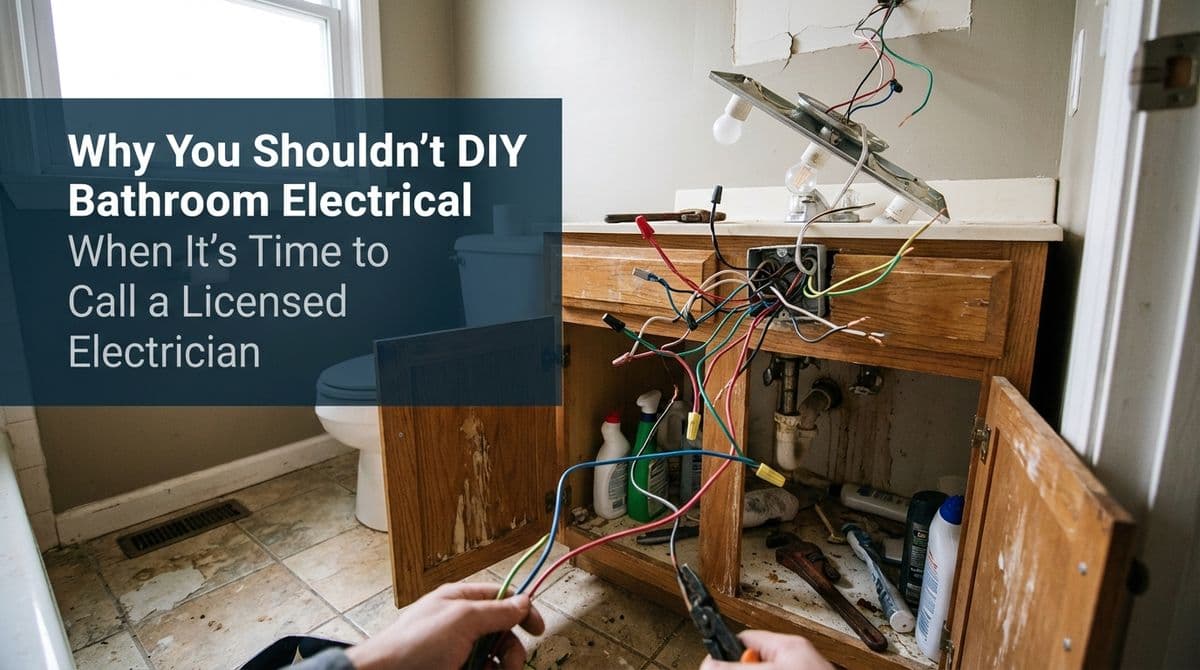
We recently got a call from one of our contractor clients — let’s call her Laura — who was in the middle of a bathroom remodel with a homeowner. The owner had said, “Oh, I can just move the plugs myself, that’s fine.” They even pulled an electrical permit under the homeowner’s name. But as soon as they opened up the wall, Laura realized the wiring behind it was a lot more complicated (and a lot stranger) than anyone expected.
By the time she called us, they had already decided it would be safer to have us run a new circuit from the panel to the bathroom instead of trying to tie into the old, odd wiring. That one phone call is a perfect example of why bathroom electrical is not the place for DIY.
What We Found When We Stepped On-Site
When we meet a client like Laura on-site, the first thing we do is listen. We ask questions like:
- What walls are moving or being opened up?
- Are you adding or relocating outlets, lights, or a fan?
- Is there any new equipment going in (heated floors, whirlpool tub, bidet, large vanity lights)?
- What did you find when you opened the walls?
In situations like this, homeowners often tell us, “It looked straightforward, but once we opened the wall, the old stuff was… odd.” That usually means we’re looking at a mix of outdated wiring methods, splices in random locations, and circuits that don’t quite make sense.
From there, we’ll trace the existing bathroom circuit, test loads, and decide whether it’s safer and more cost-effective to start fresh with a new dedicated bathroom circuit — just like Laura asked us to do.
Why Bathroom Electrical Is Different (and Riskier) Than Other Rooms
Bathrooms combine water, steam, and electricity in a very small space. Because of that, electrical codes treat them differently from living rooms or bedrooms. Here are a few reasons they’re especially tricky for DIY work:
- Dedicated circuits: Modern code generally requires at least one dedicated 20-amp circuit to serve bathroom receptacles only. DIY attempts often tie into an existing bedroom or hallway circuit, which can overload the wiring and cause nuisance tripping or worse.
- GFCI protection: Every bathroom outlet must have ground-fault (GFCI) protection. Miswired GFCIs might “work” but fail to trip when needed — exactly when you’re standing barefoot on a wet floor.
- Moisture and corrosion: Bathrooms see more humidity than almost any other room. Boxes, connections, and fixtures have to be selected and installed with that in mind.
- Clearance rules: Outlets, switches, and lights all have spacing and clearance requirements around showers, tubs, and sinks. A few inches in the wrong direction can be a code violation.
These are the kinds of details we’re always thinking about when we design a bathroom circuit. They’re also the details that are very easy for a DIYer to miss.
The Hidden Problems We Often See Behind Bathroom Walls
When someone says the existing wiring is “a little odd,” we know to expect surprises. During bathroom remodels, we commonly find:
- Mixed generations of wiring: Older cloth-insulated wires spliced to newer cable, sometimes with no junction box.
- Buried junctions: Splices left hidden behind drywall — a big no-no for future troubleshooting and fire safety.
- Overloaded circuits: Bathroom outlets tied into lighting circuits or even kitchen circuits, causing frequent breaker trips.
- No equipment ground: Older two-wire circuits feeding modern three-prong receptacles, giving a false sense of safety.
From a DIY perspective, it might look like, “just move that outlet over a foot.” From our perspective, we might be looking at a circuit that really needs to be replaced, not patched.
Why Pulling a Permit Doesn’t Make DIY Work Safe
In Laura’s project, the homeowner did the right thing by pulling an electrical permit. But a permit doesn’t automatically make the work safe — it just means the work can be inspected. Here’s where we see DIY bathroom projects go off-track:
- Underestimating scope: Once walls are open, the project goes from “move a plug” to “rewire half the circuit” very quickly.
- Misreading code: National and local codes change; online advice is often outdated or incomplete.
- Failing inspections: Even if a DIYer plans to pass inspection, it often takes multiple corrections — each one adding time and cost.
When we’re involved from the start, we design the wiring with current code in mind, coordinate with the inspector, and handle any questions or corrections on the spot.
What a Professional Bathroom Electrical Visit Looks Like
If you call us before (or during) a bathroom remodel, here’s typically how we walk you through it:
- On-site walkthrough: We look at your layout, listen to your plans, and examine any opened walls and the existing panel.
- Load and safety check: We check whether your panel can handle a new bathroom circuit and look for any red flags in the existing wiring.
- Options and pricing: We explain your choices — for example, running a new dedicated circuit, upgrading GFCIs, adding a vent fan, or separating lighting and receptacle circuits.
- Code-compliant design: We plan outlet locations, switch placement, and lighting so they’re both convenient and up to code.
- Rough-in and final: We handle the rough wiring during the remodel and return for trim-out (devices, covers, and fixtures) after tile and paint are complete.
Our goal is to leave you with a bathroom that’s not only beautiful but also safe, reliable, and ready to pass inspection the first time.
When It’s Time to Put the Tools Down and Call an Electrician
We understand the temptation to DIY — especially when walls are already open and you’re trying to save money. But in bathrooms, the risk of shock and fire is simply higher. We always recommend calling a licensed electrician if:
- You discover old, confusing, or “odd” wiring once walls are opened.
- You’re adding or moving any outlets, lights, or fans near water.
- The breaker trips when you use hair dryers, curling irons, or space heaters.
- You’re not 100% sure how to size circuits, breakers, or wire.
- You’ve pulled a permit but aren’t confident you can meet current code.
If you’re in the middle of a bathroom remodel — or about to start one — it’s always cheaper and safer to bring us in early than to fix problems after the tile is up. Just like we did for Laura, we can step in, sort out the “odd” wiring, and run a clean, code-compliant circuit that will serve your bathroom safely for years to come.